


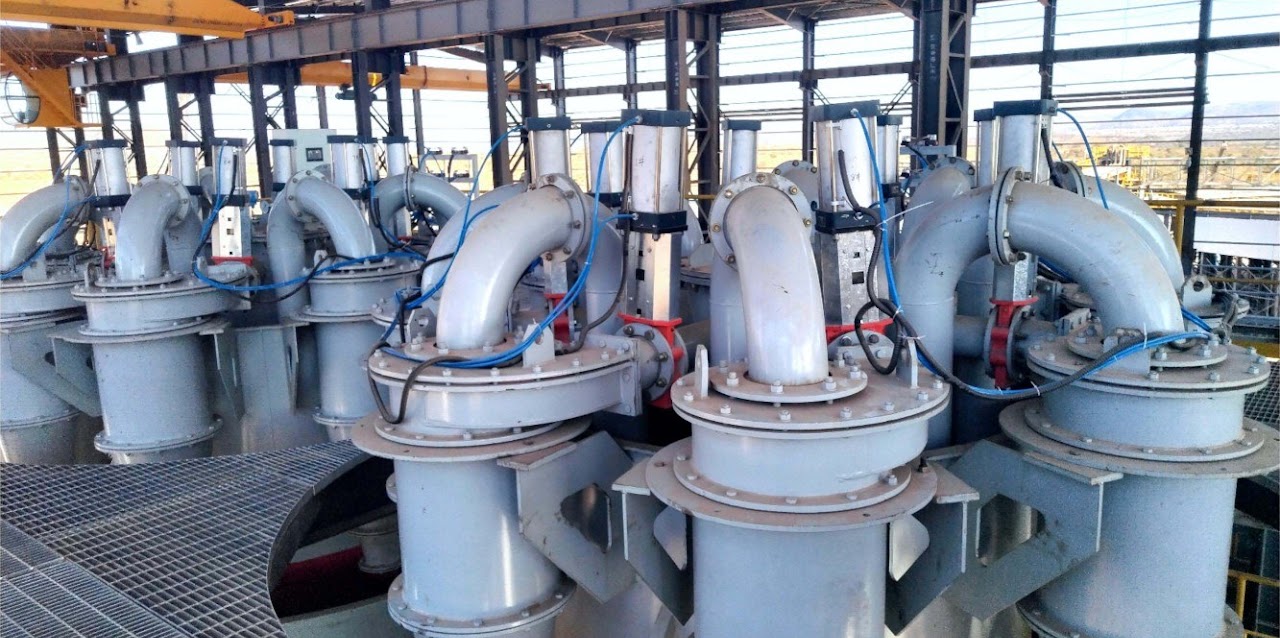
Application
AI modelling for cyclone feed, overflow and underflow density prediction in the mining industry, particularly in processes like mineral processing, involves using data-driven techniques to predict and control the density of the slurry in a cyclone. This approach utilises various process variables such as slurry flow rate, particle size distribution, pressure at the cyclone inlet and outlet, and cyclone dimensions. Often density is not measured online and only sampled data is available, which would still allow for the training of the Minealytics Density model to predict the density in the absence of online readings.
In traditional systems, pressure control and PID (Proportional-Integral-Derivative) based density control are commonly used. These systems rely on set points and manual adjustments to maintain the desired density. However, they often struggle with the variability and complex nature of the process, leading to suboptimal performance.
Minealytics utilises neural network models to model cyclone density by leveraging large datasets that encompass various process parameters like slurry flow rate, pressure, and particle size distribution. These neural networks, a form of deep learning, are trained on historical data to identify complex, non-linear patterns and relationships within the data. Once trained, the neural network can predict cyclone density with high accuracy, enabling proactive adjustments to the cyclone’s operating parameters. This predictive capability is extremely beneficial for controlling cyclones as it allows for real-time optimisation of the separation process. By predicting density fluctuations before they occur, Minealytics’ neural network models enable the implementation of preemptive measures, thus ensuring more consistent cyclone performance, reducing wear and tear, and improving overall efficiency. This approach not only enhances the accuracy of cyclone density control but also contributes to a more efficient, automated, and data-driven operational process in mining operations.
Solution: Minealytics Cyclone Density Model
The Minealytics Cyclone models continuously analyse a vast amount of data from sensors and historians in real time. The model inputs include feed hopper level and water addition, feed pump load, feed pressure, flow, density, active cyclone configuration, and underflow vibration. The models use advanced algorithms, such as machine learning or deep learning, to learn from this data and make predictions about the cyclone’s performance. This allows for more accurate and dynamic adjustments than traditional methods. The advantages of using AI for cyclone density prediction include:
- Enhanced prediction accuracy: AI models can handle complex, non-linear relationships between variables, leading to more accurate predictions of cyclone density.
- Real-time optimisation: AI can process data in real time, allowing for immediate adjustments to optimise the cyclone’s performance.
- Adaptability: AI models can continuously learn and adapt to changing conditions in the cyclone, such as variations in ore type or particle size distribution.
- Reduced operator reliance: by automating the control process, AI reduces the need for manual intervention, leading to more consistent operations.
- Energy efficiency: optimised control of cyclone density can lead to more efficient separation processes, reducing energy consumption.
Minealytics AI models offer a more sophisticated and adaptable approach to cyclone density prediction and control compared to traditional pressure and PID-based systems. This leads to enhanced performance, consistency, and efficiency in mineral processing operations.
For the longer-term maintenance signal, see Cyclone Apex Liner Wear Estimation. It uses the pressure-conditioned relationship between density and underflow behaviour to estimate liner wear, with physical inspections used for calibration and confirmation.
Technology
Temporal Neural Networks (TNNs) are a class of neural network architectures designed specifically for handling time series data. They are tailored to capture temporal dependencies and patterns within sequential data, making them well-suited for time series prediction tasks.
Unlike traditional neural networks that assume independence among inputs, TNNs are built to recognise and learn from the sequential nature of time series data. They are adept at capturing both short-term and long-term dependencies in data, which is crucial for accurate time series forecasting. TNNs can handle various types of time series data, including univariate (single variable) and multivariate (multiple variables) series.
Key Features of Temporal Neural Networks
TNNs often incorporate mechanisms to remember and utilise past information, which is essential for understanding time-dependent patterns. This memory can be implicit, as in the case of certain types of recurrent neural networks (RNNs), or explicit, as in memory-augmented neural networks. TNNs can account for time lags of varying lengths, allowing them to make predictions based on both recent and more distant past data. They can adapt to changes in the underlying patterns of the time series, which is important in dynamic environments where the data-generating process may evolve over time.
Minealytics TNN Architectures
- Recurrent Neural Networks (RNNs): a foundational architecture for TNNs, designed to process sequences by maintaining a hidden state that carries information across time steps.
- LSTMs: a type of RNN that is particularly effective for time series prediction. They can capture long-term dependencies while avoiding issues like vanishing or exploding gradients.
- GRUs: similar to LSTMs, a more streamlined variant that can also capture long-term dependencies but with a simpler structure.
- Temporal Convolutional Networks (TCNs): use causal convolutions, enabling the network to look only at past and present data without peeking into the future, which is crucial for making predictions.
- Attention-based models (Transformers): can weigh the importance of different time steps in the series, focusing on the most relevant parts of the sequence for making predictions.
Operating mode
Configured per site
The approved operating mode depends on the site, available data, validation results and safety case. A capability may begin as monitoring or advice, then progress to supervised or closed-loop control. Existing PLC, DCS and safety interlocks remain the final authority on what equipment can do.
Read about deployment and assurance