


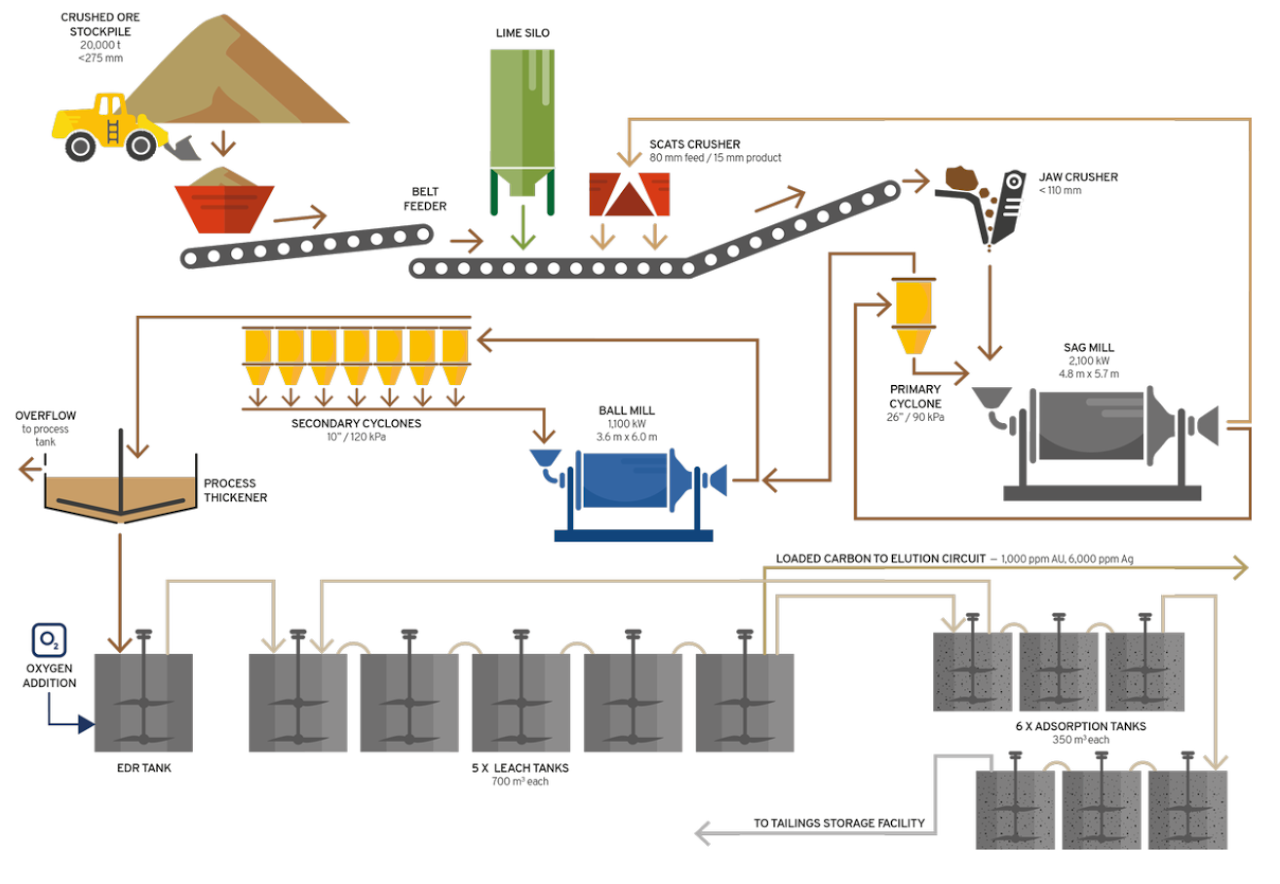
Application
pH control in SAG (Semi-Autogenous Grinding) mills is a critical aspect of the milling process in mineral processing operations, particularly in circuits where subsequent flotation is used for mineral separation. The pH level in the milling process can significantly affect the chemical environment, impacting not only the efficiency of the grinding itself but also the performance of downstream processes like flotation:
- Mineral liberation: the efficiency of mineral liberation during grinding can be influenced by the slurry’s pH, affecting the surface properties of the minerals.
- Equipment wear: the pH level can impact the corrosion rates of the mill’s internal components, and a controlled pH can help protect against excessive wear and tear.
- Flotation behaviour: many minerals are sensitive to the pH of the slurry, which affects their surface charge and, consequently, their behaviour in flotation processes. For example, the flotation of sulphide minerals is often optimised in slightly alkaline conditions.
- Reagent effectiveness: the effectiveness of various reagents used in the flotation process, such as collectors, frothers, and depressants, can be pH-dependent.
Lime is the most common reagent used to adjust the pH upwards (making it more alkaline) in SAG mill circuits. It is added either directly to the mill or to the primary conditioning tanks. pH sensors in SAG mill circuits can be prone to scaling, fouling, and wear due to the abrasive nature of the slurry, requiring regular maintenance and calibration. The variability in ore composition, feed rate, and water chemistry can lead to rapid changes in the slurry’s pH, challenging the control system’s responsiveness. Ensuring that the added reagents are well-dispersed and mixed within the slurry can be challenging, especially in large-volume circuits.
Minealytics’ use of neural control for lime addition in a SAG mill involves leveraging neural networks, a subset of artificial intelligence and machine learning, to manage the pH level of the mill slurry.
Solution: Time Series Forecasting for Neural Control
Minealytics’ predictive control, powered by our neural model, can forecast pH changes based on current and historical data, allowing for preemptive adjustments before the pH moves outside the desired range. Neural networks excel at modelling complex, non-linear relationships, making them well-suited for predicting pH in the variable and dynamic environment of a SAG mill. A neural model can integrate a wide range of input variables, including feed characteristics, water chemistry, and operational parameters, providing a comprehensive view of the factors influencing pH. Neural models can continuously learn and adapt to new patterns in the data, improving their accuracy and reliability over time as they are exposed to more operational scenarios. By predicting the optimal amount of lime or other reagents needed to maintain the desired pH, predictive control can minimise reagent consumption, reducing costs and environmental impact. Maintaining pH within a tight range enhances process stability, improving the efficiency of the milling process and the effectiveness of downstream processes like flotation. Our predictive control can lead to more consistent operations, reducing the need for manual interventions and allowing for smoother, more efficient mill operation.
Technology
The Minealytics predictive pH model uses a recurrent neural network (LSTM) to forecast slurry pH from time-series process data.
Utilising AI modelling for pH prediction provides a powerful tool for optimal lime dosing and pH control of slurry. The predicted pH from an AI model is realigned with the measured discharge pH through online training of the AI model. This real-time calibration helps in maintaining accuracy and responsiveness. Additionally, the AI can detect issues with the pH sensor by analysing patterns and inconsistencies in the data; for example, sudden, unexplained changes in pH readings, or readings that consistently diverge from model predictions without corresponding changes in operational conditions, might indicate sensor fouling, scaling, or malfunction. By continuously monitoring the sensor’s performance against expected outcomes and known process dynamics, the AI system can flag anomalies that suggest sensor issues, prompting maintenance or recalibration to ensure reliable pH control.
Operating mode
Configured per site
The approved operating mode depends on the site, available data, validation results and safety case. A capability may begin as monitoring or advice, then progress to supervised or closed-loop control. Existing PLC, DCS and safety interlocks remain the final authority on what equipment can do.
Read about deployment and assurance