


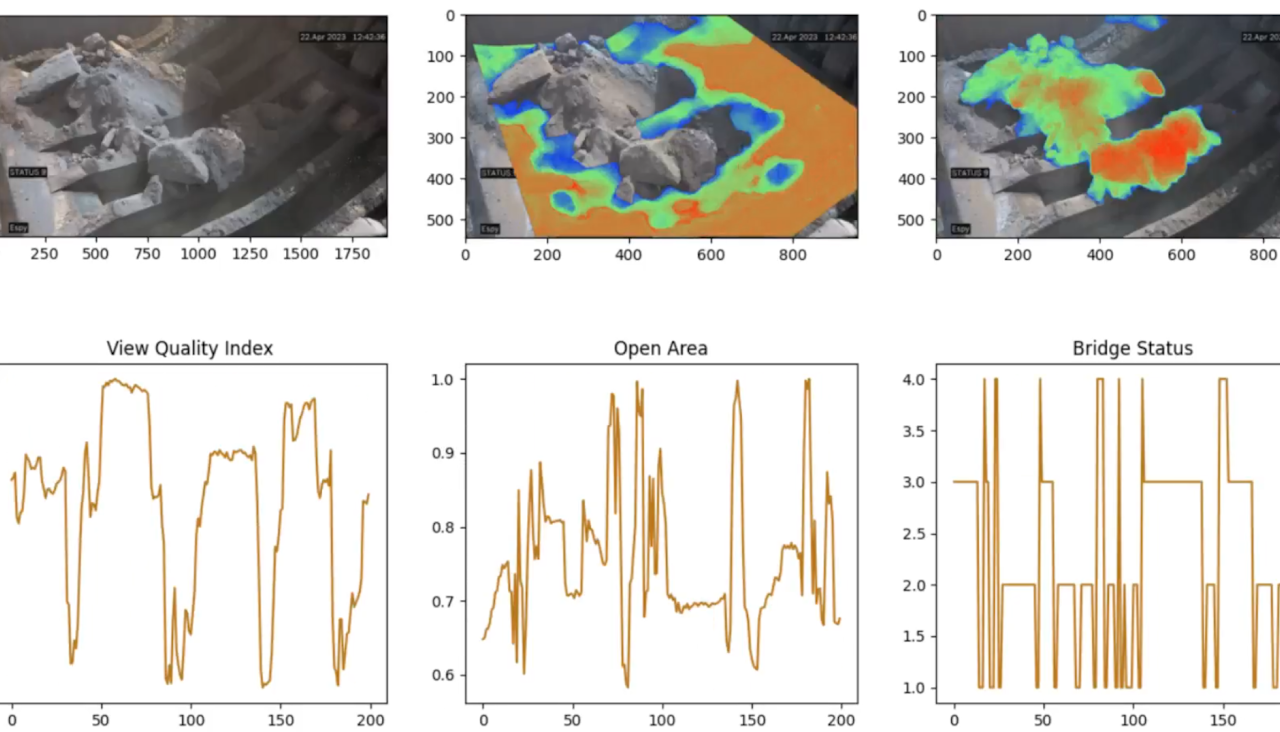
Application
Blockages in crusher bowls can be a significant source of unscheduled downtime. Detecting their position and extent can support truck-tipping decisions, primary feedrate changes and rock-breaking workflows. The system can integrate with the local control system and expose interfaces for related applications, subject to the site’s control and cybersecurity requirements.
The computer-vision solution can use standard CCTV cameras or purpose-built machine-vision cameras, depending on the field of view, lighting and detection task. It can fuse visual data with additional inputs such as depth sensors or LiDAR where those signals improve the site-specific detection case.
Powered by an industrial-grade, fanless AI edge controller, the system monitors the static grizzly and publishes blockage status to approved operator and control interfaces. It differentiates between spillage, overhang and bridge formations, helping operators select an appropriate response. Traffic-light control, rock-breaking and feeder responses require site-specific integration, validation and safety review.
Bridge Detection Features
Our camera-based bridge detection systems over ROM grizzlies offer several advantages over radar-based systems. First and foremost, camera systems provide high-resolution, real-time visual feedback, enabling more precise characterisation of material properties and behaviour. This is particularly useful for detecting the early stages of bridging, where granularity and texture can be important indicators. Additionally, modern computer-vision algorithms can be trained to recognise various types of anomalies in the ore flow, providing more comprehensive monitoring capabilities.
In contrast, radar-based systems may struggle to differentiate between normal ore levels and potential bridging incidents, especially when the material characteristics are heterogeneous. They can also be affected by environmental conditions such as dust, humidity, and temperature, requiring frequent calibration for optimal performance. Moreover, radar systems only provide distance or depth information, which may not be sufficient to analyse the nature or cause of a potential bridging scenario.
Camera-based systems can provide visual evidence for data-driven analysis and real-time decision support. Their usefulness depends on camera placement, lighting, dust, training data and the response that the site can safely execute.
Technology
By training a machine-learning model on labelled images of typical and atypical ore conditions, Minealytics can achieve a high level of granularity in real-time monitoring. For example, the algorithm can be trained to recognise and differentiate between ore, empty space, and potential bridges. When the system detects a bridge forming, it can alert operators to take corrective action immediately, thus preventing potential jams, equipment damage, or inefficiencies.
Semantic segmentation can support real-time bridge detection and, when combined with time-series process data, may support predictive analysis. The prediction horizon, event definition and response are validated against the site data before they are used operationally.
Operating mode
Configured per site
The approved operating mode depends on the site, available data, validation results and safety case. A capability may begin as monitoring or advice, then progress to supervised or closed-loop control. Existing PLC, DCS and safety interlocks remain the final authority on what equipment can do.
Read about deployment and assurance