


Applications
Contaminants such as timber and other organic materials, fibreglass roof bolts, plastics (e.g. road signage, bollards), and tramp metal present significant challenges in bulk material handling and processing. In surface mining environments, particularly in bauxite and iron ore operations, such materials are often inadvertently excavated and conveyed alongside the ore. In underground mining, fibreglass roof bolts present a challenge when they contaminate the ore.
Timber fragments can obstruct chutes and crushers, or, if crushed, degrade downstream refining processes through organic contamination. Similarly, fibreglass and plastics introduce impurities that are difficult to separate and may damage processing equipment, while tramp metal poses both a safety hazard and a risk of severe mechanical damage when mixed with ferrous ore streams.
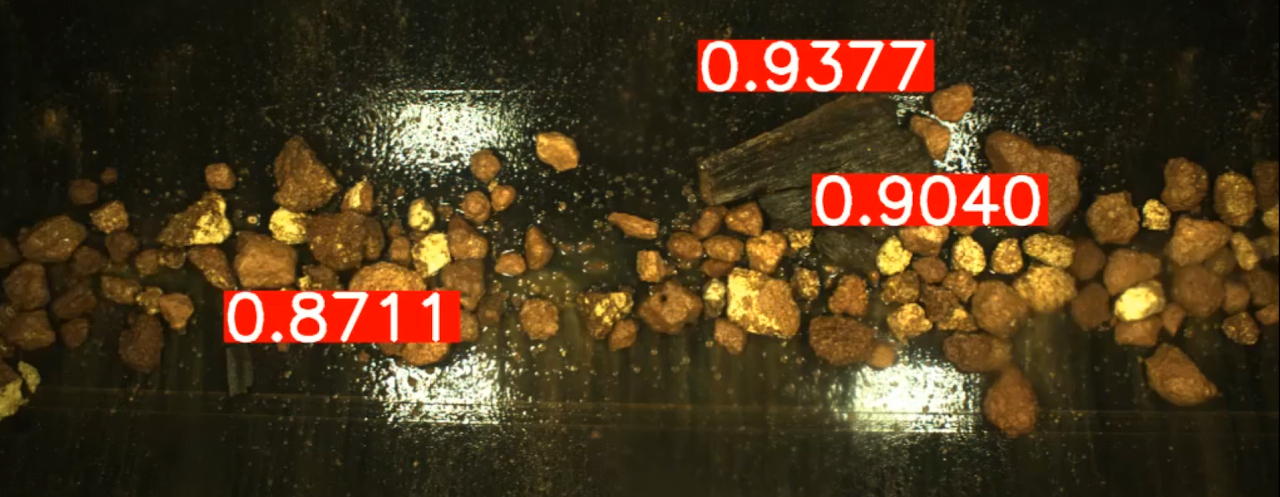
To address these challenges, we have developed a real-time contamination detection system based on advanced object-detection neural networks. Operating directly over the conveyor, the system continuously analyses video feeds to identify, classify, and localise contaminants of varying size, shape, and composition — from small fibreglass fragments to large timber logs up to two metres long.
The system can detect and track contaminants in real time, generating signals that integrate with the Process Control System (PCS). Detection performance depends on the site camera, lighting, object classes and labelled data. When a contaminant is identified, the PCS may trigger approved responses, such as activating a diverter gate or halting the feed.
By providing continuous monitoring and decision support at the source, this technology can help reduce contamination-related downtime and protect equipment and product quality. The measurable benefit depends on detection performance, response time and the approved diversion workflow.
Benefits
Increased Efficiency. An AI-based contamination detection system can automatically identify and classify various contaminants such as timber and other organic materials, fibreglass roof bolts, plastics (e.g. signage, bollards), and tramp metal in real time with high accuracy. This enables immediate response and isolation of contaminants, maintaining a smooth and uninterrupted material flow. By reducing the need for manual inspection and preventing blockages or equipment stoppages, the system significantly improves plant throughput and operational uptime.
Improved Product Quality. By detecting and removing contaminants before they enter downstream processes, the system ensures that only clean ore proceeds to refining. This minimises the risk of organic or foreign material interference in chemical reactions, improves product purity, and enhances the overall quality of the final product.
Enhanced Safety. Automatic detection and rejection of contaminants reduce the likelihood of crusher or chute blockages, conveyor belt damage, and metallic impact events. This not only protects equipment from costly damage but also eliminates the need for manual intervention in hazardous areas. By reducing human exposure to moving machinery and material flow, the system provides a safer, more controlled working environment while maintaining consistent process performance.
Technology
By leveraging modern object-detection neural networks, a real-time contamination detection system can automatically identify and localise unwanted materials — such as tramp metal, timber and other organic materials, fibreglass (roof bolts), plastics (bollards and signage), or debris — on a running conveyor. These models operate on high-speed video feeds, detecting foreign objects frame-by-frame and providing precise bounding boxes or segmentation masks for each detected contaminant. When integrated into the plant’s control network, such detections can trigger alarms, activate rejection mechanisms, or log contamination events for downstream analysis.
Unlike traditional rule-based or colour-thresholding systems, deep-learning-based detectors can adapt to variations in ore texture, lighting, and object orientation. Once trained on representative datasets, they can reliably detect different contamination types and sizes in real time, even under harsh industrial conditions.
Design Considerations
Developing an effective real-time detection system requires a careful balance between speed, accuracy, and robustness. The main parameters and considerations include:
- Frame rate and latency: the inference time per frame must stay below the video frame interval. Low latency ensures detections align with the actual position of contaminants on the belt.
- Input resolution: higher resolutions improve small-object detection but increase computational load. Optimal resolution depends on object size, conveyor width, and camera height.
- Model architecture and size: lightweight convolutional or transformer-based models (e.g. real-time optimised backbones) are preferred for embedded GPU or edge deployment. Quantisation, pruning and CUDA optimisation can further reduce latency.
- Confidence thresholds: setting detection confidence appropriately avoids false positives from ore texture variations while maintaining sensitivity to rare contamination events.
- Non-maximum suppression (NMS): used to consolidate overlapping detections, balancing responsiveness and detection stability.
- Lighting and imaging conditions: controlled illumination or infrared imaging improves detection reliability across day/night cycles and variable ore reflectance.
To maintain continuity across frames, inter-frame tracking algorithms (e.g. optical flow or feature-based tracking) associate detections over time. This allows the system to:
- Estimate object trajectories to determine whether contaminants persist or exit the field of view.
- Filter out transient false detections from dust or glare.
- Estimate belt-speed-corrected object positions, enabling precise downstream actuation (e.g. rejection gate timing).
Tracking stability depends on consistent frame timing, camera calibration, and reliable bounding-box overlap between frames.
Operating mode
Configured per site
The approved operating mode depends on the site, available data, validation results and safety case. A capability may begin as monitoring or advice, then progress to supervised or closed-loop control. Existing PLC, DCS and safety interlocks remain the final authority on what equipment can do.
Read about deployment and assurance