


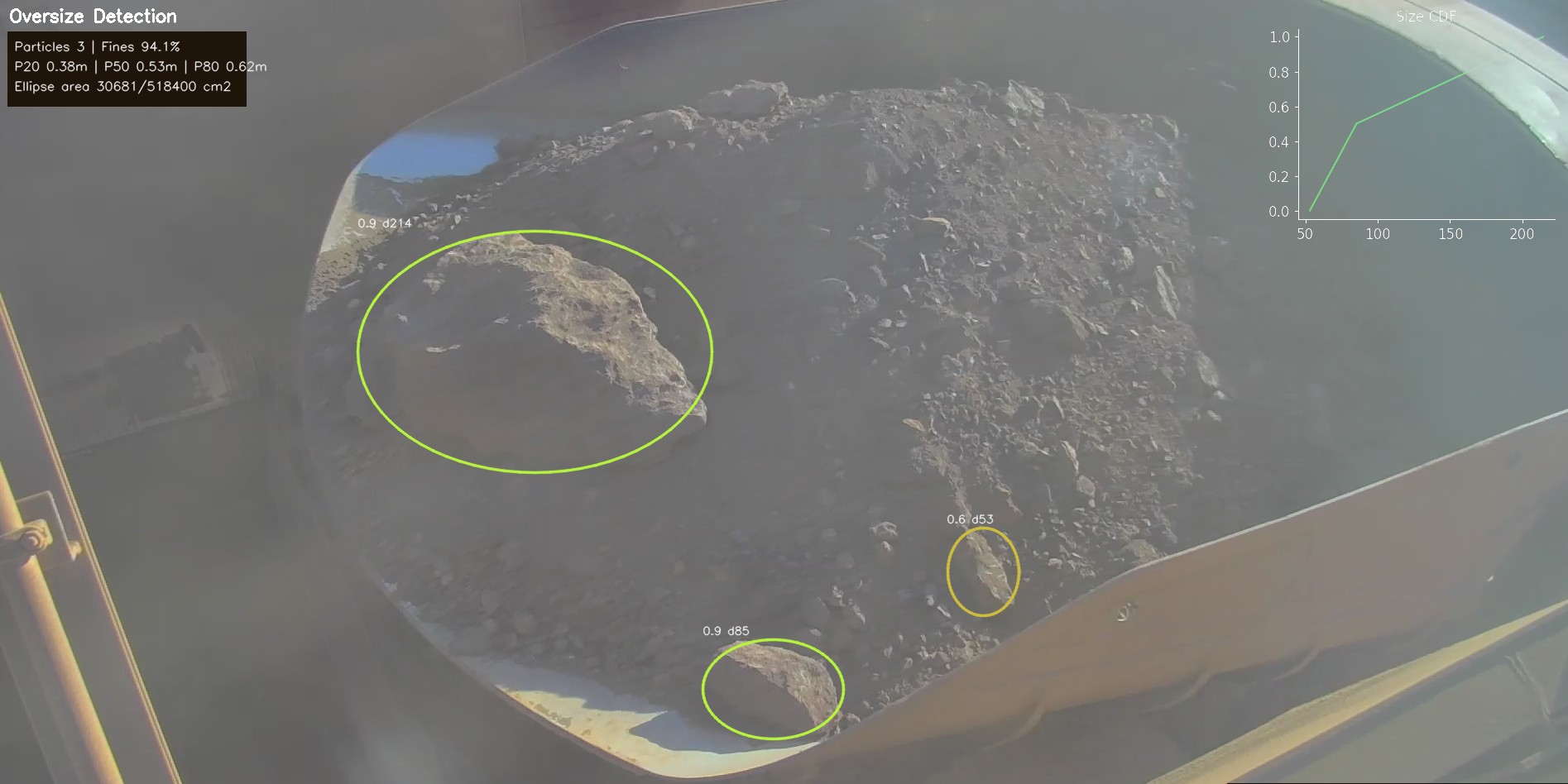
Application
Oversize and rock-breaking events can be a major source of crushing downtime, but their contribution varies by site and operating practice. Oversize material is unavoidable, and its management is needed to process material at the safest and most effective point in the circuit. Large pieces of ore can form bridges, obstruct flow, increase equipment loading and require intervention. Often, oversize is also useful feedback for mine and blasting practice. Real-time monitoring can support earlier, better-informed responses while preserving the site’s existing control and safety boundaries.
In the field of mining, one of the most significant areas where object detection could have a substantial impact is in detecting and managing oversize. Minealytics offers a comprehensive end-to-end solution for Oversize Management and Control.
System Description
Oversize Detection
Minealytics uses object-detection models to estimate the size and location of oversize material in real time and expose it to the control system and operations dashboard. In harsh, dusty environments, such as above a jaw crusher, a specialised laser camera can augment the vision data where the site design requires it.
Prevention and Control
Mass flow-based control is used uniformly for primary control of product discharge flow in a crushing circuit. While a number of feed-forward strategies have been trialled (bin level, AF hydraulic system pressure, AF current, grizzly/crusher current ratio, crusher current, etc.), they have all suffered from the deficiencies of the underlying model. Minealytics can provide more actionable insight about the load conditions than any of the listed process signals, which can then enhance the existing apron feeder throughput model and its control scheme.
Minealytics can integrate with the following subsystems within the PCS to improve crusher utilisation:
- Operator:
- Reduce the chance of missed bridges
- Reduce time to respond to bridges
- Remove load on operators by monitoring the camera feeds
- Provide preventive feedback about the likelihood of bridge formation
- Mine / Blasting:
- Oversize feedback to the mine for blasting optimisation
- Control System:
- Vibrating grizzly oversize loading feedback control
- Crusher blocked interlock to apron feeder
- Enhanced apron feeder control scheme
Closed-loop control of the apron feed can be enhanced via the feedback of vibrating grizzly load, which would substantially alleviate the chance of packing and overloading bridges in the primary crusher.
Minealytics offers real-time machine-learning models that can predict the chance of a bridge forming based on the combination of visual and PCS data (e.g. crusher current, apron feeder hydraulic system pressure, ROM bin level, etc.).
Recovery
Minealytics offers an integrated, vendor-agnostic Autonomous Rock Breaking (ARB) algorithm that can support rock-breaker positioning above detected bridges. Any automatic initiation of rock-breaking is subject to the machine, site controls and approved safety case.
The Minealytics ARB has been evaluated in a purpose-built rock-breaker simulation environment. The environment models machine dynamics and obstacles, allowing positioning and collision behaviour to be tested before site deployment. Any live operating mode remains specific to the machine, environment, controls integration and site safety case.
Technology
Modern real-time object-detection networks can identify oversize in primary feed or primary crushed ore and localise it over conveyors, crushers, hoppers, truck trays and loader buckets. The model family is selected against the site’s latency, camera geometry, object scale, lighting, edge hardware and required response. This keeps the solution portable rather than tying the operating case to one framework.
Current candidate types include lightweight one-stage convolutional detectors for low-latency edge inference; end-to-end transformer detectors such as RT-DETRv2 for real-time detection without a separate proposal and suppression pipeline; and newer real-time DETR-style detectors such as D-FINE, which targets fine-grained localisation. Where the outline or area of an object matters, an instance-segmentation variant may be more useful than bounding boxes alone. The selected network is validated against the site’s false-alarm tolerance, missed-detection cost, available compute and response workflow.
Operating mode
Configured per site
The approved operating mode depends on the site, available data, validation results and safety case. A capability may begin as monitoring or advice, then progress to supervised or closed-loop control. Existing PLC, DCS and safety interlocks remain the final authority on what equipment can do.
Read about deployment and assurance