


Application
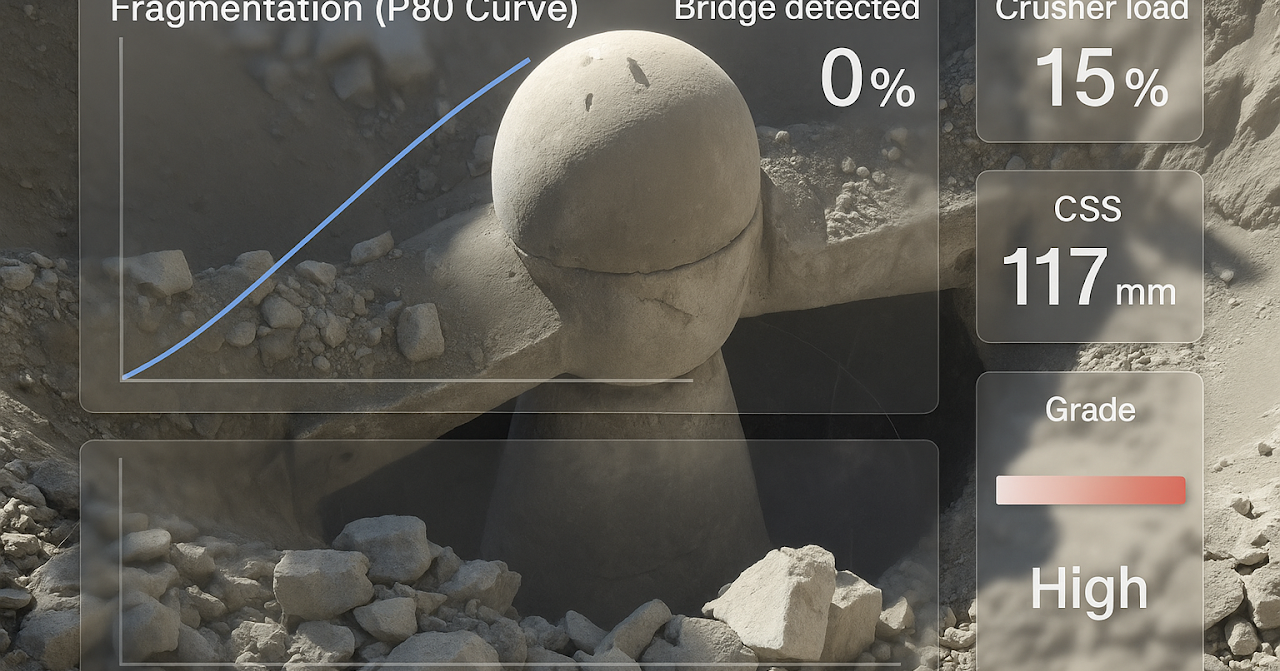
In the mining industry, the transition from fixed-gap to dynamic-gap control in crushers marks a significant advancement in operational efficiency. Fixed-gap crushers, with their static settings, are inherently inefficient, as they cannot adapt to variations in the size and hardness of the input material. This rigidity often leads to sub-optimal performance, including over-crushing or under-crushing, which can result in production loss and increased energy consumption and wear on the machinery. In contrast, dynamic-gap control, empowered by real-time data and Minealytics’ predictive algorithms, adjusts the crusher gap automatically based on continuous measurements of infeed and discharge particle sizes. By constantly monitoring these sizes, the system can predict the optimal gap setting required to achieve the desired crushing outcome. This adaptive approach not only ensures a more consistent product size but also enhances throughput, reduces energy usage, and prolongs the lifespan of the equipment. The ability to fine-tune the crushing process in real time, responding to changing material characteristics, makes dynamic-gap control a vastly superior and more sustainable option in modern mining operations.
Crusher work index is generally determined by machine-learning models. An extended version of the Minealytics crusher index prediction incorporates the images of ore fed into the crusher.
Particle Size Detection
Our model predicts the average energy use of the crusher within 10% accuracy using image inputs alone. Further process data significantly increases the accuracy. This model forms part of the Minealytics Dynamic Crusher Control module that controls closed side setting and crusher speed.
Neural Modeling of Ore Characteristics
The impact of ore hardness on the crushing process is a critical factor in mining operations, yet it poses a significant challenge in terms of measurement and modelling. Ore hardness directly influences the amount of energy required for effective crushing, the wear rate on crushing equipment, and the overall efficiency of the process. Traditional methods of estimating ore hardness through crusher parameters, such as electrical current draw, offer some insights but are often inadequate. These parameters can indicate changes in the crushing load, but the relationship between current draw and ore hardness is not straightforward and can be influenced by various other factors, making empirical modelling difficult and often unreliable.
This complexity has led to the exploration of advanced techniques like neural models for a more accurate assessment of ore hardness. Neural networks, with their ability to learn from large datasets and identify intricate patterns, can be trained on a range of data inputs, including crusher operation parameters, to develop a more precise understanding of the relationship between these variables and ore hardness. By continuously analysing operational data, these models can adapt to the subtle changes in ore characteristics, providing a dynamic and more accurate representation of ore hardness in real time. This capability is especially valuable in optimising the crushing process, as it allows for more informed and responsive adjustments to the crusher settings, improving energy efficiency, reducing equipment wear, and enhancing overall process control. In the realm of data-driven, AI-enhanced mining operations, the use of neural models for measuring ore hardness exemplifies the shift towards more sophisticated, adaptive, and efficient management of natural resources.
Crusher load and work index depend on:
- Ore characteristics: particle size, density, hardness and abrasiveness
- Environmental factors: such as moisture content
- Crusher parameters: speed, shaft position, CSS, etc.
The Minealytics Neural Crusher model uses visual and time-series inputs to determine the work index.
Computer Vision
Visual data, when leveraged through advanced computer-vision technologies, can effectively substitute for the traditionally used but often unreliable inputs of particle size, density, and moisture in the mining industry. Traditional methods of measuring these parameters can be fraught with inaccuracies due to manual sampling errors, equipment limitations, and variations in material properties. Computer vision, on the other hand, utilises high-resolution cameras and sophisticated image-processing algorithms to continuously monitor and analyse the physical characteristics of the material in real time.
For particle size determination, computer-vision systems can accurately measure the dimensions of materials on a conveyor belt or within the crusher, providing a more consistent and comprehensive understanding than intermittent manual sampling or sieve analysis. This method allows for the immediate detection of size-distribution changes, enabling quicker adjustments to the crushing process.
When it comes to assessing material density and moisture content, while direct measurement through visual data can be challenging, computer vision can infer these properties indirectly. By analysing the texture, colour, and other visual characteristics of the material, and correlating these with known properties, the system can provide estimates of density and moisture levels. This approach, although indirect, can offer a more reliable and continuous monitoring solution compared to traditional methods, which may be invasive, time-consuming, or subject to environmental interference.
Incorporating visual data into the control systems of crushing operations thus presents a substantial advantage. It enables a more accurate, real-time analysis of the material being processed, leading to enhanced efficiency, optimisation of the crushing parameters, and ultimately a more consistent and high-quality product output. This shift towards visual data analysis is a quintessential example of how data-driven, AI and computer-vision technologies are revolutionising traditional practices in the mining industry.
The crusher parameters of speed and shaft position do not change within a single tip, so those are used along with the image input. The energy input is considered proportional to the new crack-tip length created during particle breakage, and equivalent to the work represented by the product minus the feed.
Technology
Our technology uses Convolutional Neural Networks (CNNs) to accurately predict material flow rates from several variables including current apron feeder speed and current flow rate, crusher power draw, vibration and shaft position. Depending on the equipment and setup, any number of variables can be added to help model the future flow rate. CNNs are traditionally known for their prowess in image and video recognition tasks. However, their ability to recognise patterns in spatial data makes them a powerful tool for time series prediction as well. CNNs can automatically learn relevant features from the raw time series data, which makes feature engineering a less tedious task. CNNs are generally robust to noise and outliers, thanks to their hierarchical feature learning. This makes them well-suited for feedrate estimation, where data is generally noisy due to high flow rate, vibration, equipment malfunction, sensor errors, or other operational issues. Convolutional layers can learn to recognise both local and global patterns in time series data, which is crucial when dealing with feedrate estimation where short-term fluctuations and long-term trends both play significant roles.
In summary, CNN-based time series prediction for feedrate estimation offers a robust, scalable, and accurate solution, well-aligned with our goal of transforming mining into a more data-driven and autonomous industry.
Operating mode
Configured per site
The approved operating mode depends on the site, available data, validation results and safety case. A capability may begin as monitoring or advice, then progress to supervised or closed-loop control. Existing PLC, DCS and safety interlocks remain the final authority on what equipment can do.
Read about deployment and assurance